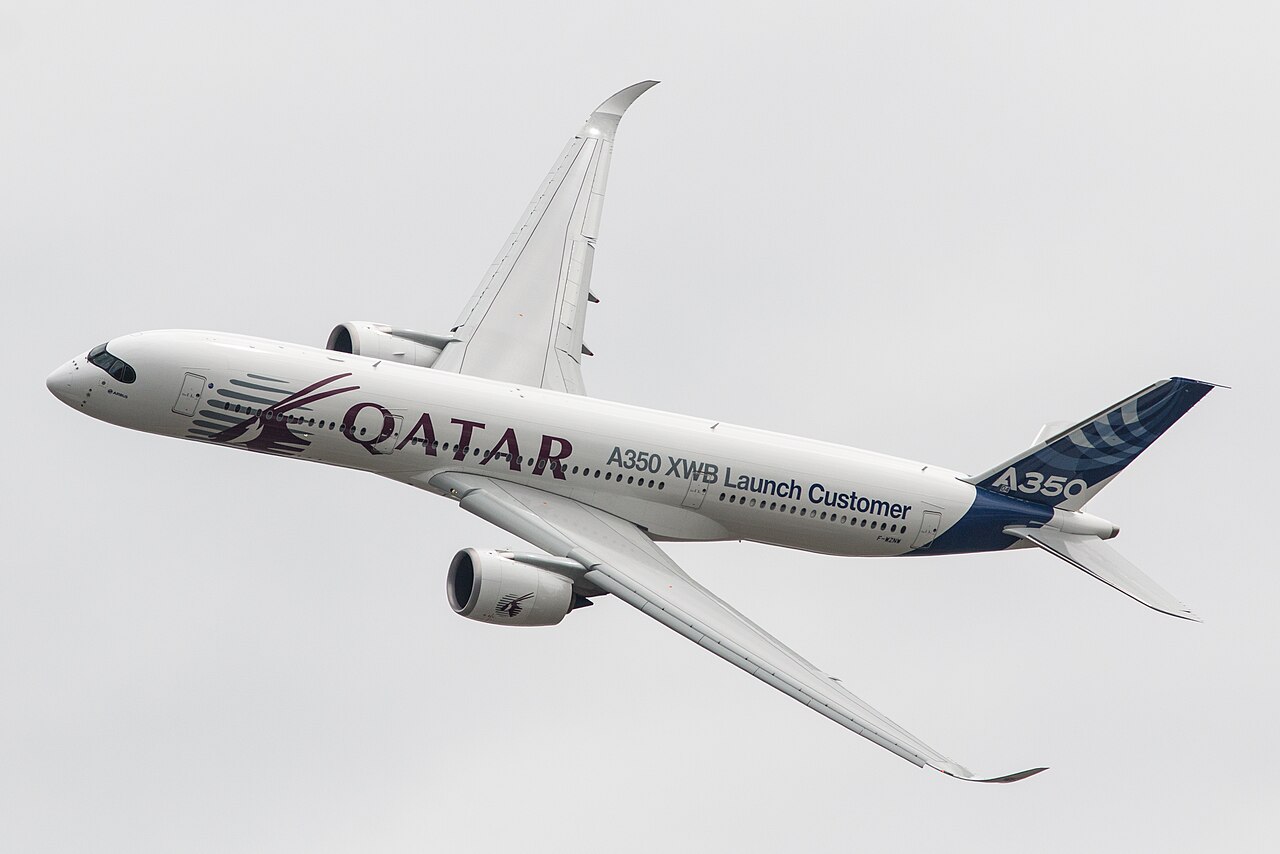
The Genesis of a Game-Changer: The Airbus A350 XWB Family
In the fiercely competitive world of long-haul aviation, Airbus rose to the challenge of the 21st century with its ambitious A350 program. Initially conceived in 2004 as a more modest evolution of the popular A330, complete with composite wings and new engines, market feedback quickly steered Airbus towards a more revolutionary path. By 2006, the vision transformed into the "Extra Wide Body" (XWB) design – a clean-sheet approach that would redefine modern wide-body air travel.
The A350 XWB is a testament to cutting-edge engineering, powered by two highly efficient Rolls-Royce Trent XWB high bypass turbofan engines. Its most distinctive feature is its construction: it's the first Airbus aircraft to be predominantly made from carbon-fibre-reinforced polymers. This revolutionary material choice delivers significant benefits in terms of weight reduction, fuel efficiency, and structural strength, allowing for a more comfortable cabin environment.
The prototype took to the skies for the first time on 14 June 2013 from Toulouse, France, marking a significant milestone. Following rigorous testing, it received type certification from the European Aviation Safety Agency (EASA) in September 2014, with Federal Aviation Administration (FAA) certification following two months later. The A350 family, therefore, isn't just an aircraft; it's a statement of technological prowess and a direct competitor to Boeing's offerings in the long-range market. For a deeper dive into the A350's material innovations, you might find
Airbus A350 XWB: The Carbon Fiber Revolution in Aviation an insightful read.
A Tale of Two Titans: A350-900 vs. A350-1000
While both the A350-900 and A350-1000 share the same advanced XWB platform, they are tailored for distinct market segments, offering airlines flexibility in capacity and range. Understanding their differences is key to appreciating their strategic roles in global aviation.
Here’s a quick comparative overview:
- A350-900: Typically carries 300 to 350 passengers, boasts a range of 15,750 kilometers (8,500 nautical miles), and has a maximum takeoff weight (MTOW) of 283 tonnes (624,000 lbs).
- A350-1000: Accommodates 350 to 410 passengers, extends its reach to 16,700 kilometers (9,000 nautical miles), and commands a higher MTOW of 322 tonnes (710,000 lbs).
The Versatile A350-900: A Workhorse for Global Routes
The A350-900, the first variant to enter service, is a true workhorse. With its capacity for 300 to 350 passengers in a typical three-class configuration, it strikes an optimal balance between payload and range. Its ability to cover distances up to 15,750 kilometers (8,500 nautical miles) makes it ideal for a vast network of international routes, from transcontinental flights across North America and Europe to long-haul journeys connecting Asia with the Middle East or Australia.
Launch operator Qatar Airways introduced the A350-900 on 15 January 2015, quickly establishing its reliability and efficiency. Airlines appreciate its operational flexibility, allowing them to open new routes or increase frequencies on existing ones without over-committing to larger aircraft. Singapore Airlines, for instance, is a major operator, leveraging the -900's capabilities for its extensive network. This variant’s sweet spot lies in its ability to serve high-demand routes that don't quite necessitate the ultra-high capacity of its larger sibling, yet require significant range and passenger comfort.
The Extended A350-1000: Powering Ultra-Long Haul
Stepping up in size and capability, the A350-1000 is the largest member of the A350 family. It's instantly recognizable by its longer fuselage, which allows it to comfortably accommodate 350 to 410 passengers. This increased capacity, coupled with an extended maximum range of 16,700 kilometers (9,000 nautical miles), positions the A350-1000 as a prime contender for the world's most demanding ultra-long-haul routes.
The increased maximum takeoff weight (MTOW) of 322 tonnes is critical here, enabling the aircraft to carry more fuel and cargo over greater distances. This makes it particularly attractive for airlines looking to operate non-stop flights between major global hubs that might otherwise require a stopover. Qatar Airways also launched the A350-1000 into service on 24 February 2018, once again demonstrating their confidence in the A350 platform. Its formidable range and capacity make it a direct competitor in the very long-range, high-density market segment.
Beyond Numbers: Passenger Experience and Operational Advantages
While specifications are important, the true success of an aircraft like the A350 lies in its ability to deliver an exceptional experience for both passengers and operators.
Cabin Comfort: A Wider Perspective
One of the most significant selling points of the A350 XWB is its cabin. The "Extra Wide Body" designation isn't just marketing; it translates directly into passenger comfort. The fuselage is designed around a 3-3-3 nine-across economy cross-section, which is a notable increase from the eight-across 2-4-2 configuration found in older wide-bodies like the A330/A340. This provides more personal space for passengers, even in economy. It's worth noting that some airlines opt for a 3-4-3 ten-across economy seating on select aircraft to maximize capacity, though the standard is the more generous 3-3-3.
Beyond seat width, the carbon fiber fuselage allows for a host of cabin environment improvements. Passengers benefit from a higher cabin pressure equivalent to a lower altitude (typically 6,000 feet instead of 8,000 feet), and increased humidity levels. These factors significantly reduce the effects of jet lag and dehydration, making long flights feel less arduous. Coupled with advanced air filtration, sophisticated LED lighting systems that mimic natural daylight, and state-of-the-art inflight entertainment, the A350 offers a noticeably quieter and more pleasant journey.
Operational Efficiency and Environmental Impact
For airlines, the A350 family offers compelling operational advantages. The Rolls-Royce Trent XWB engines are not only powerful but exceptionally fuel-efficient, leading to lower operating costs and a reduced carbon footprint. This efficiency is a critical factor for airlines facing rising fuel prices and increasing environmental regulations. The aircraft's advanced aerodynamics and lightweight composite structure also contribute to its impressive fuel burn figures.
Furthermore, the A350 boasts a common type rating with the A330. This means pilots certified to fly the A330 can be cross-trained to fly the A350 with minimal additional training, streamlining crew scheduling and reducing training costs for airlines that operate both types. This commonality is a significant practical tip for airlines looking to optimize their pilot pools.
As of January 2026, the A350 family has seen remarkable success. A total of 1,529 aircraft have been ordered, with 700 delivered and 699 actively in service with 38 operators worldwide. Singapore Airlines leads as the largest operator with 65 aircraft, while Turkish Airlines holds the distinction of being the largest customer with 110 aircraft on order. The global A350 fleet has already completed over 2 million flights on more than 1,365 routes, safely transporting over 530 million passengers with an exemplary safety record of no fatalities. This track record underscores its reliability and the confidence placed in it by major airlines globally.
The A350 in the Global Aviation Landscape: Future and Competition
The Airbus A350 family stands as a cornerstone of modern long-haul aviation, effectively succeeding the venerable A340 and directly competing with Boeing’s Dreamliner (787) and 777X series. Its combination of efficiency, range, and passenger comfort positions it perfectly to meet current and future demands for global connectivity.
The distinct capabilities of the A350-900 and A350-1000 allow airlines to precisely match aircraft to route requirements, optimizing profitability and passenger satisfaction. From connecting major business hubs to serving burgeoning tourist destinations, the A350 variants offer solutions for a diverse array of operational needs.
It's interesting to note that while the A350 is a flagship for many, other aircraft also play crucial roles in global long-haul travel. For example, American Airlines' flight **AA35**, a popular long-haul route connecting Dallas (DFW) to Auckland (AKL), is typically operated by a Boeing 787-9. This highlights the diverse strategies airlines employ, choosing specific aircraft types like the 787 or A350 based on various factors like fleet commonality, specific route economics, and partnership agreements. More details about this specific flight can be found in
AA35 Flight: American's Boeing 787-9 Long-Haul to Auckland.
Conclusion
The Airbus A350-900 and A350-1000 represent the pinnacle of modern twin-engine wide-body design. While sharing a common, revolutionary XWB platform built on carbon fiber and powered by advanced Trent XWB engines, they offer distinct advantages tailored to different long-haul markets. The A350-900 serves as a versatile, efficient workhorse for a broad spectrum of international routes, while the A350-1000 extends capacity and range to tackle the most demanding ultra-long-haul journeys. Both variants prioritize passenger comfort with wider cabins, improved cabin environments, and quieter flights, making them firm favorites among travelers and operators alike. With an impressive order book and a growing presence in global fleets, the A350 family is set to continue shaping the future of long-distance air travel for decades to come.